LAWIN & DRAWIN

Treaty with the Delawares (1778)
The Treaty with the Delawares, signed on September 17, 1778, was the first formal treaty between the United States and an Indigenous nation. It was negotiated between representatives of the United States and leaders of the Lenape (Delaware) during the American Revolutionary War.
The treaty established a military alliance and granted the United States safe passage through Lenape territory in exchange for promises of peace, protection, and trade. It also included a provision stating that, if the Lenape and other Indigenous nations chose to form a broader political body, they could potentially be admitted into the United States with representation, subject to mutual agreement. This provision was conditional and was never carried out.
Although intended to strengthen relations during the Revolutionary War, the treaty's promises were not fully realized. Conflict, shifting military alliances, and continued expansion into Indigenous lands undermined the agreement in the years that followed.
Today, the Treaty with the Delawares is historically significant as the first treaty entered into by the United States with an Indigenous nation. It remains an important document for understanding early U.S.–Indigenous diplomacy, the role of Indigenous nations during the Revolutionary era, and the legal foundations of treaty relations between the United States and Tribal nations.
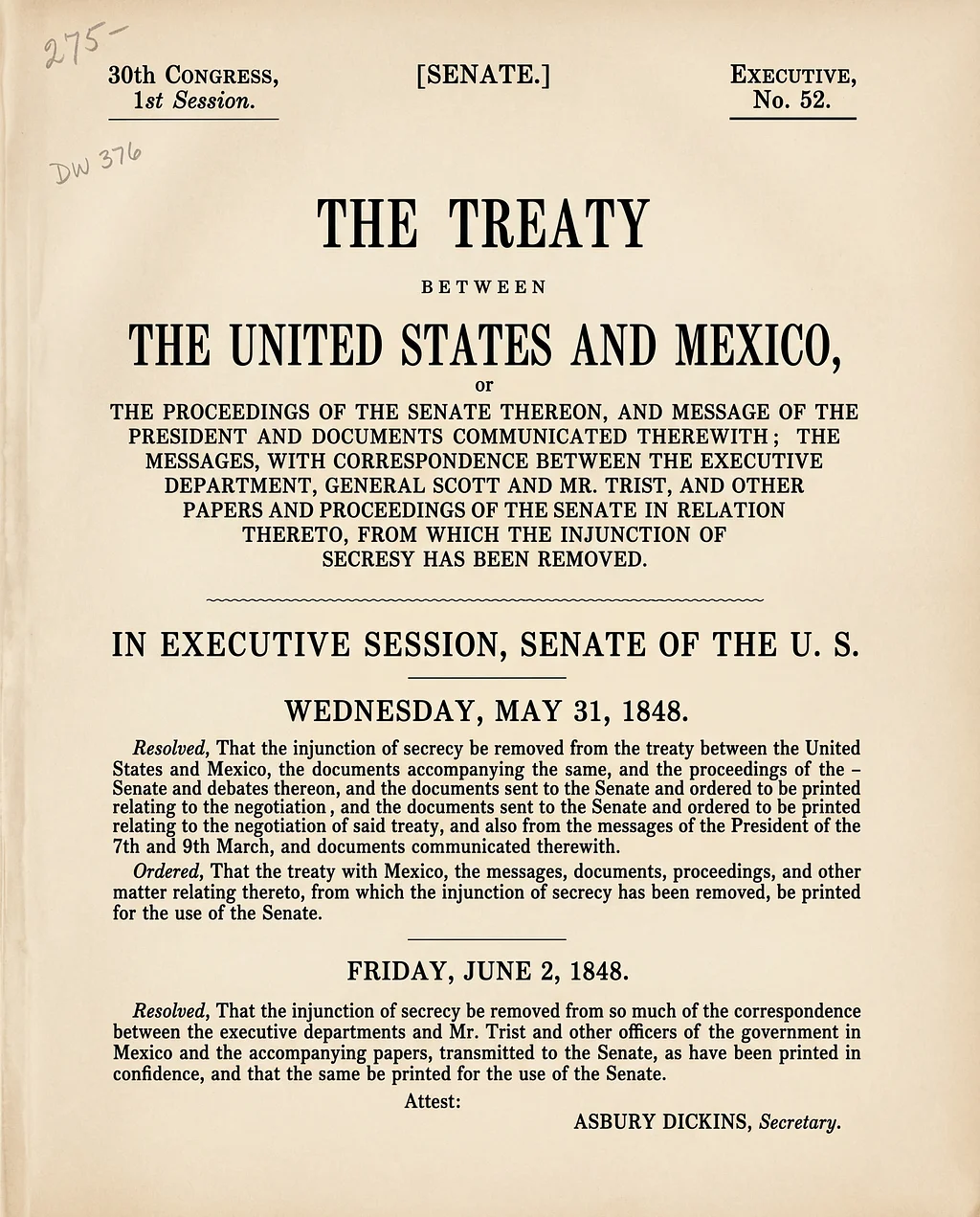
Treaty of Guadalupe Hidalgo (1848)
The Treaty of Guadalupe Hidalgo, signed on February 2, 1848, ended the Mexican–American War between the United States and Mexico. The treaty established peace, recognized the Rio Grande as the boundary of Texas, and transferred approximately 525,000 square miles of territory from Mexico to the United States. This land now includes all or part of present-day California, Nevada, Utah, Arizona, New Mexico, Colorado, and Wyoming.
In return, the United States agreed to pay Mexico $15 million and assume certain financial claims of U.S. citizens against Mexico. The treaty also provided that Mexican citizens living in the ceded territories could choose to remain and become U.S. citizens or relocate to Mexico, and it stated that their property rights were to be respected.
The treaty affected the homelands of many Indigenous nations, including the Apache, Navajo, Comanche, Ute, Pueblo, and others. Although the treaty transferred sovereignty over these lands from Mexico to the United States, Indigenous nations were not parties to the negotiations and did not sign the treaty.
Today, the Treaty of Guadalupe Hidalgo remains one of the most significant agreements in North American history because it reshaped the map of the continent, established much of the modern U.S.–Mexico border, and continues to influence discussions involving land rights, treaty history, and the legal status of property originating in the ceded territories.
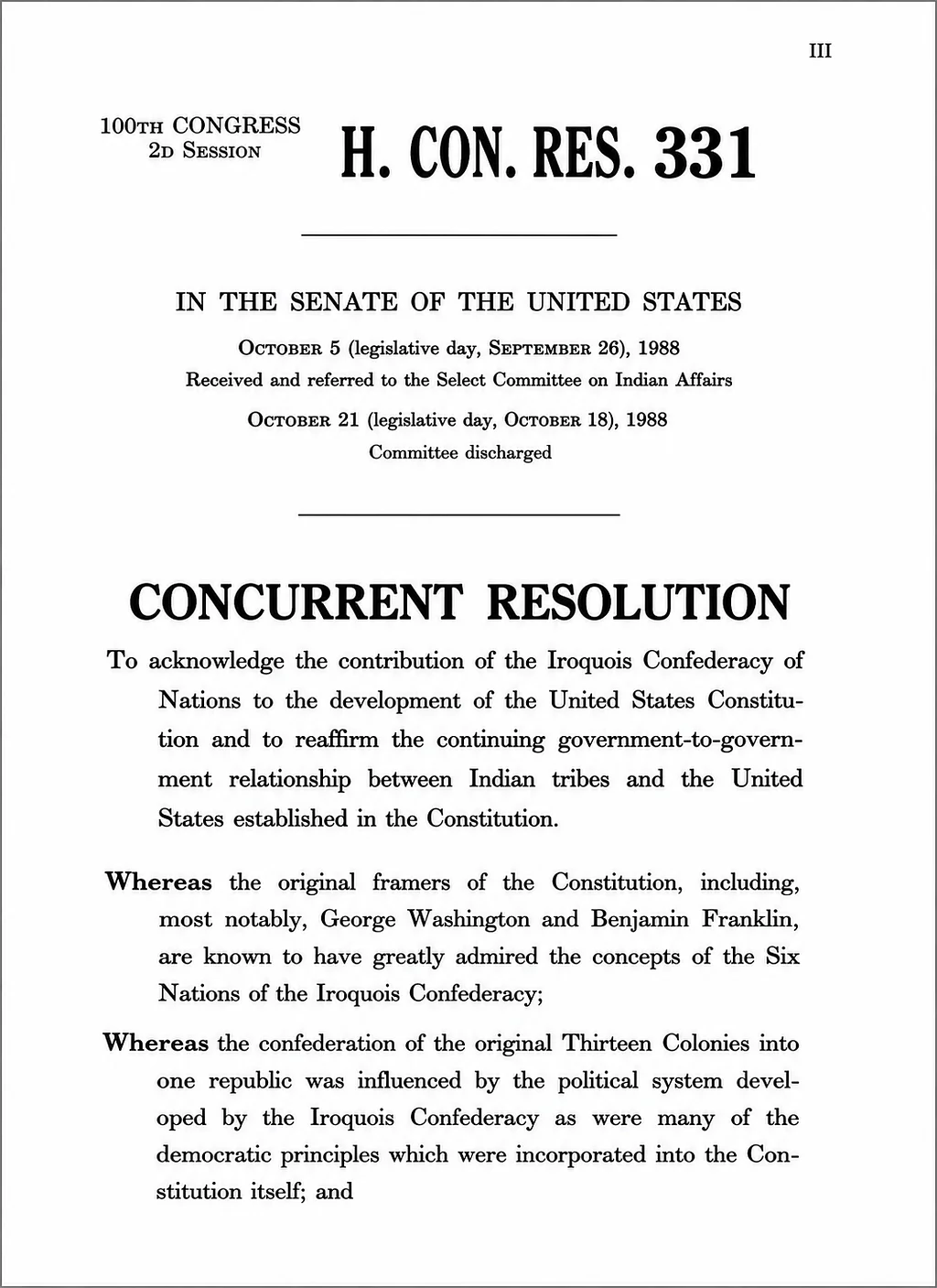
H. Con. Res. 331 (1988) — Summary
H. Con. Res. 331, adopted by the United States Congress in 1988, formally recognizes the historical influence of the Haudenosaunee Confederacy (Iroquois Confederacy) on the development of the United States Constitution and the nation's democratic traditions.
The resolution acknowledges that leading American founders, including George Washington and Benjamin Franklin, studied and admired the political system of the Six Nations. It recognizes that principles such as representative government, federal union, deliberation among member nations, and the maintenance of government-to-government relationships influenced the political ideas that contributed to the formation of the United States.
The resolution also reaffirms the continuing government-to-government relationship between federally recognized Indian tribes and the United States, recognizing tribal sovereignty and the enduring importance of Native nations in American constitutional history.
Importantly, H. Con. Res. 331 is a congressional concurrent resolution, meaning it expresses the official recognition and sentiment of Congress but does not create new law or alter legal rights. Its significance lies in its formal acknowledgment of Indigenous contributions to American political development.
Key Facts
- Document: H. Con. Res. 331
- Congress: 100th Congress, 2nd Session
- Year: 1988
- Purpose: To acknowledge the contribution of the Haudenosaunee (Iroquois Confederacy) to the development of the United States Constitution and reaffirm the government-to-government relationship between Indian tribes and the United States.
- Historical Significance: One of the clearest official statements by Congress recognizing the influence of Indigenous political traditions on the founding of the United States.